‌
^
‌
‌
‌
‌
#
A
B
C
D
E
F
G
H
I
J
K
L
M
N
O
P
Q
R
S
T
U
V
W
X
Y
Z
‌
::
+
‌
"
?
‌
‌
Showing posts with label ~c:note. Show all posts

B-Item

B-Item

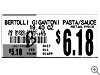
n. An ITEM that's slated to soon be DISCONTINUED. You can easily recognize them because PRICE CONTROL overwrites their SHELF TAGS with a bold letter “B”. See also SHELF TAG NOTATIONS.

NOTE: Notice the “B” gets written over the SHELF TAG'S BAR CODE. That reminds the person holding the GUN, “Don't re-order any B-Items!” After all, it wouldn't make sense to ORDER more of something you're about to get rid of.

HOW TO: Handle B-ITEMS

  1. Fill the SHELF, same as always, anytime you encounter a B-ITEM. The only difference is what you do with the leftovers...
  2. Any left?
    1. Put a large “B” on the CASE with your MARKER, and circle it to draw attention to the CASE NOTATION.
    2. Drop it off in RECEIVING on the designated SHELF in the RACK back by the GATE. If there's not enough space, leave it on the floor nearby.


The ultimate fate of a B-Item is typically either the DISCONTINUED ITEMS RACK, where CUSTOMERS may pick up a bargain, or the RECOVERY PALLET.

Backdrop

Backdrop

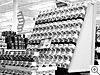
n. A raised, shallow, and slightly tilted shelving area behind and above a FAST-WALL, EVZ or END-CAP DISPLAY were additional amounts of the ON-SALE PRODUCT are STACKED as a curtain to create an eye-catching background for a SIGN. Also, SHADOW BOX.

NOTE: Lightweight ITEMS, like cereal BOXES may be STACKED for the full height of the Backdrop. Heavy ITEMS like the cans in the photo at right, are often STACKED on a series of special, narrow metal SHELVES that may be inserted into the slots between the slats of the Backdrop surface.

Back-set Offset Row

Back-set Offset Row

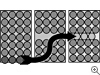
n. An arrangement for like cans, bottles or other round ITEMS in a HOLE that allows a greater than usual number GO while still maintaining a straight FACE and good BLOCK. See also JAM, MAKE IT GO, PACKING THEORY.

NOTE: Whenever jars or cans slightly overhang the lip, or there's a gap between the BLOCK at the FACE and the rest of the STOCK on the SHELF, or if there's a significant fractional can or jar's worth of wasted space right up at the front, you may have an opportunity to get slightly—sometimes significantly—more PRODUCT up. Just shift a row of PRODUCT three or more rows back from the FRONT sideways, left or right, so that it's “hills” fit into the “valleys” of the row behind it, similar to the way the teeth of two gears mesh. Repeat the offset process as often as necessary to make the first three rows sit flush with the front edge of the SHELF, alternating left and right, and moving backwards towards the back of the HOLE. This compresses the distance between the centers of jars or cans in the offset rows, making a tighter “lattice” and thus more will GO to the SHELF. Candidates? Premium canned soups or tomato PRODUCTS, jars of spaghetti sauce, those little jars of baby food, etc.

TIP: Best Face Forward. Any time you place Back-set Offset Rows, the foremost Offset Row should ideally be at least three or more rows behind the SHELF FACE, so that it's less obtrusive (see where the arrow's pointing to the three highlighted circles in middle of the rightmost illustration pane, above).

Badge

Badge

n. Your official NAME TAG, issued by the STORE upon hiring.

NOTE: If you're a MANAGER or FULL-TIME EMPLOYEE, your Badge is gold metalized plastic and your name is engraved. MANAGERS get pocket-protector-style Badges, FULL-TIME EMPLOYEES' have pin-backs. If you're PART-TIME, like me, it's white PLASTIC and your name is applied as a piece of printed labeling TAPE.

Besides the individual EMPLOYEE'S name, Badges show the STORE'S logo and motto. At least for PART-TIME EMPLOYEES, it's customary for your EMPLOYEE NUMBER to be written on the back, so you don't forget it.

Whenever you're working, you have to wear your Badge. It's part of your UNIFORM. If you lose it or forget it, see the FRONT-END MANAGER for a replacement or temporary substitute. Expect a scolding (I speak from experience) if it happens more than once.

Badge Number

Badge Number

n. A 6-digit number on the back side of the badge or name tag you're given upon being hired. The first 3 digits are the STORE NUMBER, and the last 3 are your EMPLOYEE NUMBER.

NOTE: At the TIME CLOCK you CLOCK IN/OUT and PUNCH for all breaks and meals, etc. using the entire 6-digit Badge Number.

Bale

Bale

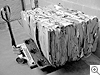
n. A great quantity of CARDBOARD that has been compressed into a large and heavy brick about the size of a side-by-side washer dryer set, and which is held together by multiple stands of iron BALE WIRE: “It's time to tie a bale.” See also, MAKE A BALE.

NOTE: When the GATE is open, BALES go onto the TRUCK. Otherwise, they're “parked” short-end forward in front of the GATE, to await arrival of the KEY.

Remember: successive BALES should always go onto the TRUCK on alternate sides, to help balance the trailer. And likewise don't forget: along with their supporting PALLETS, Bales should always be recorded on the SHEET kept at the RECEIVER'S desk.

Banana Box

Banana Box

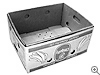
n. A heavy-duty, standard-sized BOX or carton with air holes and a tight-fitting lid that's used for shipping bananas.

NOTE: And once empty of bananas, also used for many other purposes, such as BOXING UP ITEMS too large for MILK CRATES, or by the RECEIVER during RECOVERY.

Banana Cart

Banana Cart

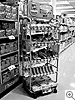
n. A decorative, vertically-oriented, wheeled CART with sling-style canvas shelves that cradle bananas, as well as other ITEMS such as banana-related gadgets or Vanilla Wafer cookies on an ordinary bottom SHELF.

NOTE: Despite its location near the TOP of the breakfast cereal aisle, the Banana Cart is kept stocked by the PRODUCE DEPARTMENT. It's a P.O.S., or Point-Of-Sale strategy: many people like bananas with their cereal, so why not make it convenient and provide what they want where they want it?

Bar Code

Bar Code

n. A SCANNER-readable numeric code composed of closely-spaced thick and thin vertical bars, as on a PRODUCT LABEL or SHELF TAG.

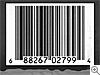
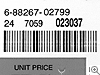
NOTE: PRODUCT LABEL and SHELF TAG Bar Codes are not the same! Compare the two photos at right, which show PRODUCT LABEL and SHELF TAG Bar Codes for the same ITEM—in this case, a 15.5‑ounce can of garbanzo beans.

The Bar Code on the PRODUCT LABEL (upper photo) is the UPC, or Universal Product Code. Its human-legible value of 6‑88267‑02799‑4 is the same in both photos. However, on the SHELF TAG (lower photo) the Bar Code is different. That's because it's a STORE CODE that includes a STOCK NUMBER for that particular ITEM—here, 023037—that the GROCERY MANAGER or NIGHT CREW CHIEF may SCAN with the GUN when ORDERING.

Barricade

Barricade

n. A gate or other obstruction generally imposed as a SECURITY measure to control access to a particular area, and specifically intended to deter THEFT. —v. To put such obstructions into place.

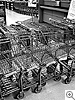
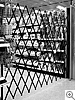
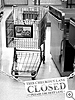
NOTE: Various Barricades are routinely put into place overnight, when fewer people are in the STORE. For instance, unused CHECKOUT REGISTER lanes have the usual “Closed” chain augmented by the addition of an empty SHOPPING CART, to discourage any who might consider ducking under and running out. In similar fashion, a number of CARTS nested together guide incoming and outgoing traffic through the area that's staffed. High-risk areas such as the cosmetics AISLE have their own movable, accordion-style gates that are put into position during the overnight hours.

Base-Cut

Base-Cut

v. To make a very shallow cut around three sides of a plastic-wrapped CASE containing a CARDBOARD TRAY, in order to allow the outer covering to be peeled back out of the way and eventually removed. —n. Any such cut. See also BOX CUTTER, H-CUT, LIFT-CUT, PEEK-CUT, SHARK-CUT, STACK-CUT, TAPE-CUT, TOP-CUT, TRAY-CUT, WINDOW-CUT, X-CUT.

NOTE: Candidates? Plastic-covered tray CASES containing jars of spaghetti sauce, jars of baby food, cans of cat or dog food, and so on.

Ordinarily, you first would make an H-CUT, extract a single can or jar out the top of the still-intact case, and only make a Base-Cut once you're fairly sure the entire CASE will GO.

However, when THROWING LOAD, except for SPECIALS (easily identified as multiple CASES of the same ITEM), the presumption is it will all GO, so you'd often employ the Base-Cut's many-at-once variation: a STACK-CUT.

BE

BE

adj. “Back End.” A notation used by the GROCERY MANAGER and others on written instructions to indicate where something GOES or may be found relative to a given AISLE, designated by number. For example, “Kill pasta BE-3,” means “SHELF OUT and then BACK-STOCK any remainder of the pasta DISPLAYED (e.g., on a END-CAP, 3-WAY, WING BASE, or SHIPPER—it should be obvious once you look) at or near the Back End of AISLE 3.” Also BACK, BOTTOM. Versus FE, FRONT, TOP.

NOTE: May be written with or without dashes or spaces, as, “BE-#”, “BE #” or “BE#”—all are equivalent.

“Best EVER... !”

“Best EVER... !”

adj. Something that is really, really G-O-O-D, good! Contrast “WORST EVER... !”.

NOTE: Feel free to nominate your own contributions to this “Best EVER...” list:

...Time to Shop. Saturdays, between 10 P.M. and Midnight is ideal. Why? No, it's not just because the STORE'S not very crowded at that time. That's true more or less every night of the week. Oh, no. There's a much better reason: it's because during those two hours on Saturday nights the SPECIALS—sales and promotions—from both the past week and the week ahead are valid at the same time. So, with careful attention to the ads in the weekly CIRCULARS (the SHELF TAGS may have already been changed over), you can save more money by taking advantage of two weeks' SALE ITEMS at once!

BOGO

BOGO

adj. “Buy One, Get One (Free),” meaning a sale where you get two of the same ITEM for the REGULAR PRICE of one. Also B1G1.

NOTE: BOGO items are not half price. If you only buy one, you still pay full price.

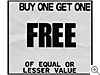
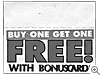
BOGO ITEM SHELF TAGS are flagged with the distinctive “FREE” decorator you see in the photo, upper right. Individual ITEMS themselves may or may not have small BOGO stickers, as in the photo, lower right. Note the PERFORATIONS. Only the top part of the sticker has adhesive, allowing the bottom, printed portion of the sticker to be torn off once the SALE is over if the ITEM goes unsold.

TRUE STORY: It's embarrassing, but I've done it. I once picked up only one unit of a BOGO item that was on sale two-for-one. At first I didn't think I needed that much, so why take two? Checkout proceeded normally. After all, it's not against the rules to bypass an opportunity. Halfway home a little light in my head sputtered back on. “D'oh!” I said, as I smacked my forehead and drove back. I took my receipt to the CUSTOMER SERVICE DESK where the nice lady behind the counter smiled and then gave me permission to go and pick up the second unit that I'd actually already paid for.

Brand

Brand

n. 1. An identification between a product or service, its manufacturer or provider, and an associated perception or value in the mind of the CUSTOMER: “I'm sorry, Ma'am. We don't happen to carry that brand.” 2. A logo, trademark of other means of promoting such an identification or association. See also STORE BRAND.

NOTE: Branding, and the building up of what's called Brand equity is a multi-billion dollar industry, involving marketing, advertising, PRODUCT placement, positioning, and so on.

For example, when you think of a facial tissue, you probably think “Kleenex®”, and when you think photocopier, you probably think “Xerox®.” Those are Brands.

TRUE STORY: Kleenex® and Xerox®, among others, are in fact such powerful national brands that the companies that own them pay big bucks to put ads in Writer's Digest and similar magazines to plead with writers not to use their Brand names as generic words. If a Brand name ever becomes generic, anyone can use the word, and the owner looses both a huge marketing advantage and a huge financial investment. For example, did you know that “zipper” was once a Brand name owned by B.F. Goodrich? Not anymore!

For more information on lost Brand names and trademarks, see, e.g.,
http://en.wikipedia.org/wiki/List_of_generic_and_genericized_trademarks

Break

Break

n. 15 minutes of time off to rest and relax. Two Breaks allowed per 8-hour SHIFT: “I'm going on break.”

NOTE: NIGHT CREW typically takes their Break all together at the same time, whenever the CREW CHIEF calls it on the PA.

DAY CREW generally take Breaks individually, to allow one another to COVER incoming calls, cashier PAGES for PRICE CHECKS, CUSTOMER questions, etc.

Break Down

Break Down

v. 1. To flatten, as CARDBOARD BOXES: “Break it down so more fits in your (shopping cart) basket.” 2. To take the nightly LOAD as off-loaded from the TRUCK on PALLETS and redistribute it by CASES onto appropriate RUNNERS for the NIGHT CREW to THROW onto SHELVES by AISLE. Usually performed by NIGHT CREW FOREMAN or CREW CHIEF before NIGHT CREW arrives. —n. The task of Breaking Down LOAD: “Who's doing break-down?”

NOTE: To break your BOXES down or not, that is the question. It takes time to do, but gives you more working space on your RUNNER and may save time because you can stuff flattened BOARD vertically between the high handle on one end of your RUNNER and some as yet un-WORKED CASES or CASES of MARKED OVERSTOCK and thus make fewer trips to the BALER.

However, if you have a RUNNER with a lot of LOAD to THROW, take along a SHOPPING CART, break down your BOARD, and toss it into the CART. It'll help keep you from going crazy. Same plan generally goes for Dairy/Frozen work, which is farther from the CRUSHER, has small CASES, and high TURNOVER.

If your WORKING SPECIALS RUNNERS, it's a judgment call. You'll seldom need a SHOPPING CART. If you do need room, you can usually just break down the BOARD and stuff it filing cabinet-wise between a heavy BOX and the handle on the end of your RUNNER.

However, if space is not an issue, you often won't need to. Just set the whole BOX aside and later toss it in whole, open-side-down, and let the CRUSHER do it's thing.

Bucket

Bucket

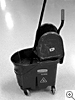
n. A janitorial set comprised of a MOP and wheeled Bucket with a compression wringer insert: “Get a bucket and clean up that spill in aisle 6.” See CLEAN-UP.

NOTE: Whenever the FLOOR is wet or damp, always warn CUSTOMERS verbally, e.g., “Watch out—the floor may be slippery,” and set a caution CONE in place before proceeding with CLEAN-UP.