^
#
A
B
C
D
E
F
G
H
I
J
K
L
M
N
O
P
Q
R
S
T
U
V
W
X
Y
Z
::
+
"
?
Showing posts with label ~c:usage. Show all posts

B-Item

B-Item

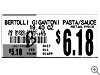
n. An ITEM that's slated to soon be DISCONTINUED. You can easily recognize them because PRICE CONTROL overwrites their SHELF TAGS with a bold letter “B”. See also SHELF TAG NOTATIONS.

NOTE: Notice the “B” gets written over the SHELF TAG'S BAR CODE. That reminds the person holding the GUN, “Don't re-order any B-Items!” After all, it wouldn't make sense to ORDER more of something you're about to get rid of.

HOW TO: Handle B-ITEMS

  1. Fill the SHELF, same as always, anytime you encounter a B-ITEM. The only difference is what you do with the leftovers...
  2. Any left?
    1. Put a large “B” on the CASE with your MARKER, and circle it to draw attention to the CASE NOTATION.
    2. Drop it off in RECEIVING on the designated SHELF in the RACK back by the GATE. If there's not enough space, leave it on the floor nearby.


The ultimate fate of a B-Item is typically either the DISCONTINUED ITEMS RACK, where CUSTOMERS may pick up a bargain, or the RECOVERY PALLET.

Bale

Bale

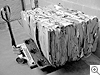
n. A great quantity of CARDBOARD that has been compressed into a large and heavy brick about the size of a side-by-side washer dryer set, and which is held together by multiple stands of iron BALE WIRE: “It's time to tie a bale.” See also, MAKE A BALE.

NOTE: When the GATE is open, BALES go onto the TRUCK. Otherwise, they're “parked” short-end forward in front of the GATE, to await arrival of the KEY.

Remember: successive BALES should always go onto the TRUCK on alternate sides, to help balance the trailer. And likewise don't forget: along with their supporting PALLETS, Bales should always be recorded on the SHEET kept at the RECEIVER'S desk.

BE

BE

adj. “Back End.” A notation used by the GROCERY MANAGER and others on written instructions to indicate where something GOES or may be found relative to a given AISLE, designated by number. For example, “Kill pasta BE-3,” means SHELF OUT and then BACK-STOCK any remainder of the pasta DISPLAYED (e.g., on a END-CAP, 3-WAY, WING BASE, or SHIPPER—it should be obvious once you look) at or near the Back End of AISLE 3.” Also BACK, BOTTOM. Versus FE, FRONT, TOP.

NOTE: May be written with or without dashes or spaces, as, “BE-#”, “BE #” or “BE#”—all are equivalent.

Block

Block

v. 1. To make PRODUCT on DISPLAY or on the SHELF more visually appealing by pulling several ranks forward to the front edge. 2. To do so for whole AISLES, or the entire STORE. Typically done by NIGHT CREW after they've finished THROWING LOAD. “OK—It's time to start blocking.” Contrast WALL‑BLOCK.

NOTE: There's one good reason to enjoy Blocking: you don't have to HUNT for the PRODUCT or it's HOLE! Thus, with a little practice, you can do it fairly quickly. Everything you need is right there in front of you!

When Blocking the top levels of DISPLAYS on END-CAPS, the FAST-WALL or the EVZ, you may choose to either bring a full rank forward by reaching to its back and pulling everything towards you, or, to lift an ITEM or two from the back rows and place them into the gaps at the front. The determining factor is which way is both faster and neater.

TIP: Block Into Your Hand. Ideally you want Block using both hands at once. However, sometimes it's best to put up one hand as a backstop on the front edge of the SHELF or DISPLAY, and bring PRODUCT forward with the other until you feel it touch. Candidates? Glass jars, or things that are prone to topple forward, like tall, top-heavy or skinny boxes.

Bottom

Bottom

adj. The end of an AISLE farthest from the checkout registers: “It's at the bottom of aisle 13.” Also, BACK or BE; versus FE, FRONT. or TOP.

Break

Break

n. 15 minutes of time off to rest and relax. Two Breaks allowed per 8-hour SHIFT: “I'm going on break.”

NOTE: NIGHT CREW typically takes their Break all together at the same time, whenever the CREW CHIEF calls it on the PA.

DAY CREW generally take Breaks individually, to allow one another to COVER incoming calls, cashier PAGES for PRICE CHECKS, CUSTOMER questions, etc.

Break Down

Break Down

v. 1. To flatten, as CARDBOARD BOXES: “Break it down so more fits in your (shopping cart) basket.” 2. To take the nightly LOAD as off-loaded from the TRUCK on PALLETS and redistribute it by CASES onto appropriate RUNNERS for the NIGHT CREW to THROW onto SHELVES by AISLE. Usually performed by NIGHT CREW FOREMAN or CREW CHIEF before NIGHT CREW arrives. —n. The task of Breaking Down LOAD: “Who's doing break-down?”

NOTE: To break your BOXES down or not, that is the question. It takes time to do, but gives you more working space on your RUNNER and may save time because you can stuff flattened BOARD vertically between the high handle on one end of your RUNNER and some as yet un-WORKED CASES or CASES of MARKED OVERSTOCK and thus make fewer trips to the BALER.

However, if you have a RUNNER with a lot of LOAD to THROW, take along a SHOPPING CART, break down your BOARD, and toss it into the CART. It'll help keep you from going crazy. Same plan generally goes for Dairy/Frozen work, which is farther from the CRUSHER, has small CASES, and high TURNOVER.

If your WORKING SPECIALS RUNNERS, it's a judgment call. You'll seldom need a SHOPPING CART. If you do need room, you can usually just break down the BOARD and stuff it filing cabinet-wise between a heavy BOX and the handle on the end of your RUNNER.

However, if space is not an issue, you often won't need to. Just set the whole BOX aside and later toss it in whole, open-side-down, and let the CRUSHER do it's thing.

Bucket

Bucket

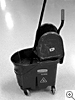
n. A janitorial set comprised of a MOP and wheeled Bucket with a compression wringer insert: “Get a bucket and clean up that spill in aisle 6.” See CLEAN-UP.

NOTE: Whenever the FLOOR is wet or damp, always warn CUSTOMERS verbally, e.g., “Watch out—the floor may be slippery,” and set a caution CONE in place before proceeding with CLEAN-UP.