^
#
A
B
C
D
E
F
G
H
I
J
K
L
M
N
O
P
Q
R
S
T
U
V
W
X
Y
Z
::
+
"
?
Showing posts with label THE SHELF. Show all posts

B-Item

B-Item

n. An ITEM that's slated to soon be DISCONTINUED. You can easily recognize them because PRICE CONTROL overwrites their SHELF TAGS with a bold letter “B”. See also SHELF TAG NOTATIONS.

NOTE: Notice the “B” gets written over the SHELF TAG'S BAR CODE. That reminds the person holding the GUN, “Don't re-order any B-Items!” After all, it wouldn't make sense to ORDER more of something you're about to get rid of.

HOW TO: Handle B-ITEMS

  1. Fill the SHELF, same as always, anytime you encounter a B-ITEM. The only difference is what you do with the leftovers...
  2. Any left?
    1. Put a large “B” on the CASE with your MARKER, and circle it to draw attention to the CASE NOTATION.
    2. Drop it off in RECEIVING on the designated SHELF in the RACK back by the GATE. If there's not enough space, leave it on the floor nearby.


The ultimate fate of a B-Item is typically either the DISCONTINUED ITEMS RACK, where CUSTOMERS may pick up a bargain, or the RECOVERY PALLET.

Back-set Offset Row

Back-set Offset Row

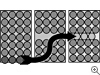
n. An arrangement for like cans, bottles or other round ITEMS in a HOLE that allows a greater than usual number GO while still maintaining a straight FACE and good BLOCK. See also JAM, MAKE IT GO, PACKING THEORY.

NOTE: Whenever jars or cans slightly overhang the lip, or there's a gap between the BLOCK at the FACE and the rest of the STOCK on the SHELF, or if there's a significant fractional can or jar's worth of wasted space right up at the front, you may have an opportunity to get slightly—sometimes significantly—more PRODUCT up. Just shift a row of PRODUCT three or more rows back from the FRONT sideways, left or right, so that it's “hills” fit into the “valleys” of the row behind it, similar to the way the teeth of two gears mesh. Repeat the offset process as often as necessary to make the first three rows sit flush with the front edge of the SHELF, alternating left and right, and moving backwards towards the back of the HOLE. This compresses the distance between the centers of jars or cans in the offset rows, making a tighter “lattice” and thus more will GO to the SHELF. Candidates? Premium canned soups or tomato PRODUCTS, jars of spaghetti sauce, those little jars of baby food, etc.

TIP: Best Face Forward. Any time you place Back-set Offset Rows, the foremost Offset Row should ideally be at least three or more rows behind the SHELF FACE, so that it's less obtrusive (see where the arrow's pointing to the three highlighted circles in middle of the rightmost illustration pane, above).

Back-Topple

Back-Topple

n. A nuisance or annoying condition akin to the domino effect, necessitating the removal of one or more ITEMS or CASES in order to set upright something that has been inadvertently pushed or toppled over towards the rear of a DISPLAY. Specifically, an unfortunate tendency of 2-liter soda bottles being slid into BOTTLE-RACES, and of TRAY-CUT CASES of cans that are being slid onto a STACK, where underlying cans in the back of the lower layer can be inadvertently displaced.

Bar Code

Bar Code

n. A SCANNER-readable numeric code composed of closely-spaced thick and thin vertical bars, as on a PRODUCT LABEL or SHELF TAG.

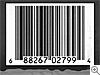
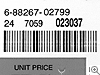
NOTE: PRODUCT LABEL and SHELF TAG Bar Codes are not the same! Compare the two photos at right, which show PRODUCT LABEL and SHELF TAG Bar Codes for the same ITEM—in this case, a 15.5‑ounce can of garbanzo beans.

The Bar Code on the PRODUCT LABEL (upper photo) is the UPC, or Universal Product Code. Its human-legible value of 6‑88267‑02799‑4 is the same in both photos. However, on the SHELF TAG (lower photo) the Bar Code is different. That's because it's a STORE CODE that includes a STOCK NUMBER for that particular ITEM—here, 023037—that the GROCERY MANAGER or NIGHT CREW CHIEF may SCAN with the GUN when ORDERING.

“Best EVER... !”

“Best EVER... !”

adj. Something that is really, really G-O-O-D, good! Contrast “WORST EVER... !”.

NOTE: Feel free to nominate your own contributions to this “Best EVER...” list:

...Time to Shop. Saturdays, between 10 P.M. and Midnight is ideal. Why? No, it's not just because the STORE'S not very crowded at that time. That's true more or less every night of the week. Oh, no. There's a much better reason: it's because during those two hours on Saturday nights the SPECIALS—sales and promotions—from both the past week and the week ahead are valid at the same time. So, with careful attention to the ads in the weekly CIRCULARS (the SHELF TAGS may have already been changed over), you can save more money by taking advantage of two weeks' SALE ITEMS at once!

Block

Block

v. 1. To make PRODUCT on DISPLAY or on the SHELF more visually appealing by pulling several ranks forward to the front edge. 2. To do so for whole AISLES, or the entire STORE. Typically done by NIGHT CREW after they've finished THROWING LOAD. “OK—It's time to start blocking.” Contrast WALL‑BLOCK.

NOTE: There's one good reason to enjoy Blocking: you don't have to HUNT for the PRODUCT or it's HOLE! Thus, with a little practice, you can do it fairly quickly. Everything you need is right there in front of you!

When Blocking the top levels of DISPLAYS on END-CAPS, the FAST-WALL or the EVZ, you may choose to either bring a full rank forward by reaching to its back and pulling everything towards you, or, to lift an ITEM or two from the back rows and place them into the gaps at the front. The determining factor is which way is both faster and neater.

TIP: Block Into Your Hand. Ideally you want Block using both hands at once. However, sometimes it's best to put up one hand as a backstop on the front edge of the SHELF or DISPLAY, and bring PRODUCT forward with the other until you feel it touch. Candidates? Glass jars, or things that are prone to topple forward, like tall, top-heavy or skinny boxes.

BOGO

BOGO

adj. “Buy One, Get One (Free),” meaning a sale where you get two of the same ITEM for the REGULAR PRICE of one. Also B1G1.

NOTE: BOGO items are not half price. If you only buy one, you still pay full price.

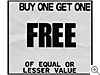
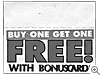
BOGO ITEM SHELF TAGS are flagged with the distinctive “FREE” decorator you see in the photo, upper right. Individual ITEMS themselves may or may not have small BOGO stickers, as in the photo, lower right. Note the PERFORATIONS. Only the top part of the sticker has adhesive, allowing the bottom, printed portion of the sticker to be torn off once the SALE is over if the ITEM goes unsold.

TRUE STORY: It's embarrassing, but I've done it. I once picked up only one unit of a BOGO item that was on sale two-for-one. At first I didn't think I needed that much, so why take two? Checkout proceeded normally. After all, it's not against the rules to bypass an opportunity. Halfway home a little light in my head sputtered back on. “D'oh!” I said, as I smacked my forehead and drove back. I took my receipt to the CUSTOMER SERVICE DESK where the nice lady behind the counter smiled and then gave me permission to go and pick up the second unit that I'd actually already paid for.

Bottle-Race

Bottle-Race

n. A device on SHELVES in the soda AISLE having an inclined plane with anti-friction grooves on its surface and a series of parallel coated wire guides perpendicular to the SHELF FACE and separated by the width of a 2-liter soda bottle, used for holding same, and which employs a gravity feed to coax bottles flush forward to the SHELF FACE in good BLOCK. Compare CAN-RACE, SPRING-TRAY. See also BACK-TOPPLE.